ATTENTION: I concluded my beekeeping journey in August 2013. For various reasons, I stopped blogging shortly after arriving in India and never resumed.

Updating this blog to reflect the completion of my research - and to convey its outcomes to those who are interested - is an ongoing process, so check back periodically if you are looking for additional info on beekeeping in India, Russia, or Germany. Even better, subscribe to this blog by e-mail (at the bottom of the page) and new posts will be sent directly to your inbox as I complete them. Thanks for visiting.

- Dillon Blankenship, 20 February, 2018.

Showing posts with label Tanzania. Show all posts

10 January, 2013

To Build a Hive

Another charge made against local beekeepers is that local style hives are "very bad" because they are destructive to forests... meaning that it would better if beekeepers switched to the box/top bar style hives. I have heard this claim from regional commissioners, forest officers, foreign beekeeping agents, and many others while I have been in Tanzania.

At first, I thought they might be right - I had seen many girdled trees during my train journey to the west and suspected these were caused by the production of bark hives - but I I refused to give in so easily.

After much effort, I have finally seen the process (and learned the facts) for myself.


"Follow the bee" - I thought the verse from Psalms on Udoya's mud flap might be related to bees, but it isn't...


 Forest permits acquired, lunches packed, and motorcycles fueled we met at 6AM and traveled 75km south into the forest to the bush camp and Udoya's 1,000 hives.


It is amazing how this beekeeper navigated through the immense forest. There were some easy references along the barely existent road, but eventually everything just looks the same. I asked if he had a map to keep track of all his hives and he told me that there is no map, that he just keeps track of them all mentally. After a few minutes of careful watching he sighted the place to turn off and we went directly to where he wanted to put some new hives. Without wasting a minute he found a fallen tree, cut a log of appropriate length, and went to work cleaning off the bark. While Charley finished smoothing the exterior, Udoya fashioned a few wedges from dead branches he found on the ground.


Next, he began the process of splitting the log, which consisted of an initial cut and then careful additions of wedges and precision strikes from a sledge hammer.


We had accomplished so much after only a few hours, but it was hard work and we were ready for lunch. Udoya guided us through the forest labyrinth to his bush camp. He and his son live here about three months out of the year while they are harvesting honey. I have heard of large crews of extended family going into the Ugalla Game Reserve for harvesting, but Udoya prefers to keep his crew small and simple (certainly increasing his personal profits).


After lunch we returned to our hive and made the final preparations. We charred the inside to attract bees and then rubbed some wax on the inside. The minerals liberated by burning are known to draw bees and starter wax is commonly used worldwide as bait for swarms. Udoya was covering his bases. I have also been told that cow dung and bananas are used in Tanzania to attract bees to new hives.


Rubbing bees wax inside the hive
After all the work I was greatly surprised when we began rigging the hive to be hung vertically! In all of my research (book and field) up to this point I had only known of horizontal hives in Tanzania (bark, log, grass, even the box hives), but this one was to be vertical and I later saw many others of the same design in the Yela Yela area. Unfortunately, the batteries in my camera died while Udoya climbed the tree (so no pictures) and hoisted our creation to its resting place.


I was able to get a picture of another vertical hive later.

Vertical log hive in a mango tree. Some trees would have as many as five or six hives scattered among their branches.
These vertical hives seem pretty nice. I think bees prefer growing vertically, but it is hard for me to say in this context because I was unable to see the inside with a living colony. Whereas it is possible to take honey without completely destroying the hive in Tanzania's local horizontal systems, I fear these vertical creations are probably very hazardous for bees during the harvest season. I don't think it is possible to leave much comb attached after taking honey (which would be stored in the wax at the top of the hive).

After much contemplation and further discussions concerning the environmental impact of local beekeepers I have come to the following conclusion. First, grass hives are never a problem. Second, the impact of girdling trees for bark hives is troubling, but could be overcome by making multiple hives from one tree. Third, log hives are okay as long as the whole tree is being utilized. There is an argument against log hives which says that log hives are made from trees which have not reached maturity, whereas professional timber companies harvest more responsibly. I think it is easier to hold timber companies accountable (though I doubt this really happens), but maintain that if beekeepers are using one tree for multiple hives, maturity is not really a problem - even if bigger trees are harvested, by the time the sides are trimmed down and pieces wasted I suspected there isn't much more timber being acquired by logging operations.

A few other thoughts.

- maybe if I made it to the really big forest in Inyonga my mind would be changed...
- taking beeks out of forest (why emphasize keeping hives close to home when thieves are a problem) will ultimately be bad for forests
- all officials acknowledge that tobacco is a bigger problem for forests, but tobacco makes a lot of money for the country and so is allowed.
- new tech is expensive
- old tech lasts a long time and is easily renewable
- old tech is hands-off; new requires much more time
- with new tech comes treatment and other interference with natural processes, ultimately weakening the present bee population which is very strong

While I have no doubt acquired much insight concerning beekeeping issues in Tanzania, I am not in a position to confidently prescribe policy or definitively say that this or that is "right" or "wrong." Ultimately, the people have to decide what works best in each community. The downside is, I fear, that the voices of those with the most knowledge and who will be most affected (the beekeepers) by changes are the least likely people to be heard when it comes to the future of apiculture in the country. 

19 December, 2012

Under the Cover of Darkness

As the sun dropped below the horizon we arrived in Mugombe village. Along with Staford and Joseph from the Kasulu Beekeeper's Cooperative Society, I was joining a group of beekeepers to harvest honey from local style hives. We were greeted by Timotheo Tinya Bilala, a beekeeper and board member of KBCS, and two other beekeeping elders. As we waited for dark to take hold we carried out introduction formalities and I was told a bit about the beekeepers of Mugombe.

Two groups are operating in the village. Group A has fifteen members and Group B has twenty members. Women make up about a quarter of each group and own hives but hire men to place hives in the forest and to harvest honey. I was told that this is because they cannot climb trees (the kanga or kitenge, which are the typical fabric skirts or dresses worn by women, get in the way), though I suspect responsibility for children and domestic obligations are larger limitations. It has been the inclination of western non-profits to use beekeeping as a tool for liberating women, but pragmatically the current situation is probably sufficient or else women can be very effective for creating secondary goods (candles, cosmetics, or even just processing raw wax and honey) which increase profits and frees men to increase their numbers of hives. Women can also be trained for making bee suits, or protectives as they are called here, but I have digressed.

The members of Group A have a total of 1,987 hives made from bark or grass with a few box style. Most of the hives are owned individually but sixty seven are owned by the group. The members of Group B, which is newly formed, have 200 total hives - fifty box hives (half owned by the group and half by individuals) and 150 local hives. They get the same amount of honey from local hives and box hives (10-15 L per harvest). They say it is easier to work in the box hives (Tanzanian Top Bar), which are built locally, but also say that they are very expensive.

As Staford translated my questions into Swahili I found myself very impressed with the records each of these men kept. Each had a notebook with pages and pages of data on numbers of hives, historical group membership, volume of honey harvested, etc from previous seasons which has been very useful for the cooperative in keeping track of its constituency and outputs. As is common, the men were not just beekeepers, but were also farming (corn, potatoes, maybe even tobacco) between honey flows.

We departed and soon arrived at the beehives just outside of the village. I was shown the traditional tools for harvesting - rope, a large paddle and spoon for manipulating honeycomb, a smoking bundle, and various buckets and tubs to contain the harvest. Each of these were shown to me and described as the "traditional" rope, "traditional" smoking bundle, etc. However, we all laughed a bit when the very modern-looking "traditional" pliers and "traditional" flashlight (torch) were revealed.

I'll let pictures (with captions) tell the rest of the story...

Timotheo primes the smoker as the rest of the party prepares to lower the hive.

In this tree you can see all three hive technologies utilized in Kasulu - (from left to right) a bark hive, a grass hive, and a box hive. It is important to note how skilled these men are at climbing trees! Men well over fifty years of age make short work of trees I can only dream of climbing and then rapidly ascend to nightmarish heights. The beekeeper is barely visible here.

The chosen one.

The honey is harvested at night because bees are calmer which makes the endeavor less dangerous. This goes against western practices where honey is harvested during the day hoping that many of the bees will be away foraging and not around to sting. I think the sometimes very cool ambient temperature is also an aid to night-harvesting African beekeepers (I worked in a hive one early morning which remained docile but became ferocious in the afternoon heat). The beekeeper removes his shirt so that bees will not get caught in the fabric and sting him. The two pictures before this one also show that, in the night, the African beekeepers are very difficult to see, perhaps confusing defensive bees. On the other hand, when my shirt is taken off and my white skin is exposed to the moon light I essentially glow in the dark..

The hive is always worked from the side opposite the entrance. The smoking bundle is placed at the rear of  the hive and the grass lid is removed. The smoke is blown in by the beekeeper at first and then left smoldering. The bees move away and the beekeeper uses a wooden paddle to break and remove comb from the inside of the hive. Once out, he uses a bundle of grass to brush away bees and then places the combs in buckets. Finally two combs are left behind (ideally one with brood and one with honey, though in practice it seems hard to tell which kind is remaining) and the hive is re-sealed.

A drawback to this harvesting method (and local style hives) is that more than just honey gets taken in the process. However, bee brood is traditionally eaten by beekeepers in Africa and is considered a normal product to harvest along with honey, wax, and propolis - we even had a special bucket for it. Brood are high in protein and have a slight almond flavor, though the juiciness can be disconcerting at first. I found the watoto ya nyuki (bee children) to taste nice enough when eaten with honey which was conveniently located a few cells over. The comb in this picture has a beautiful brood pattern. These bees were obviously of Islamic origin - they did a great job with the crescent but the star still needed some work.

Once sealed, the hive is hoisted back into the tree, the next hive is lowered for the process is repeated. It was about this time that we asked our brave friend in the tree how many stings he got while harvesting the honey. He yelled down to us "HAMNA," which means NONE!

We are showcasing the various honey harvesting implements. The man in the light blue shirt at middle-left is Joseph, the KBCS Secretary, and Timotheo is on the far right - he made sure the hive was safely lowered and returned to the tree. The courageous man in the middle did the harvesting and climbing and our friend on the far left controlled the light and inspired us with his shirt featuring scenes from Rambo movies.

I had been told all kinds of stories about how horrible it is to harvest honey from local style hives - bad for bees, bad for honey, painful for beekeepers. Maybe it was beginner's luck, but we sustained zero bee casualties from stings and, even better, no stings for beekeepers. The honey was harvested in the comb, which is made perfectly by the bees and we walked away hopeful that the bees would remain in the hive and rebuild their colony. The process was carried out rapidly and delicately so I think the bees experienced a minimal amount of stress, or at least no more than the experience by most other honey harvesting methods.

Sure, brood were taken from the hive (so many future bees were killed), selecting only sealed comb honey was impossible, and there is probably a fifty/fifty chance that the bees will abscond. There also was no consideration of the queen, so there is a chance that she was hurt in the process. However, this was not the horror show of flaming bee hives, charred bees, and dirt crusted honey many government officials would have had me believe and none of the drawbacks mentioned above are compelling enough reasons to abandon the most sustainable and time-tested beekeeping technology in the country. If any improvements could be made in the process itself I would suggest improving knowledge of the queen and of the importance of leaving enough brood and honey behind. Also, beekeepers could place more value on avoiding brood comb. They should not be told to never eat brood, but could just be encouraged to take more care when harvesting. I suspect beekeepers are no longer excited about brood food when they get to their one hundredth hive, but would prefer to not be killing bee children.


17 December, 2012

Discovering the Kasulu Beekeepers Cooperative Society

While in Kigoma I discovered a beautifully packaged jar of honey at a shop near the market. The label displayed a professional logo for Mzinga Honey (mzinga means "beehive" in Swahili), complete with barcode, tamper-proof lid, packaging date, and a small pamphlet describing the methods used by Kasulu beekeepers for harvesting and processing. Someone in the Europe or the U.S. would probably take these things for granted, but in Tanzania it is a very big accomplishment! Even more, the price for this treasure was the same as the prices being asked for sub-par honey packaged in old bottles of water or spirits with obvious fermentation and bee gunk floating on the surface.


Though my exploration of beekeeping is not honeycentric, the end-product of apiculture is a good starting point for finding hives and beekeepers. Moreover, the well-crafted jar from Kasulu (and the delicious honey within) represents successes that elude so many Tanzanian beekeepers - finding a market, including beekeepers in the business process, maintaining the perfection of the honey from hive to shelf, obtaining packaging materials, and sustaining a cooperative (unlike the failed Tabora Beekeepers Cooperative Society).

I called the phone number from the label and reached Staford Nkubhagana, the project manager for the Kasulu Beekeepers Cooperative Society. He invited me to visit him and the beekeepers in Kasulu. I never know what to expect when someone in Tanzania invites me to his or her place of business. Sometimes it is only to ask me for funding or sponsorships (which is a lost cause when they are talking to me) and sometimes it is just for me to sign the guestbook - which I have found is a practice of very high priority - while offering nothing else productive. However, as was the case for Kasulu, these invitations sometimes yield very meaningful discussions and amazing new opportunities.

Delayed by rain and afraid of buses I opted for a dala dala from Kigoma to Kasulu. In a previous post I mentioned that these small passenger vans are chronically overcrowded (twenty-two people or more in a van with enough chairs to uncomfortably seat fourteen), and this one was no exception, yet I enjoyed it much more than my previously harrowing journey by bus. Albeit incredibly uncomfortable, it was fun watching the various people jump on and jump off with various goods as they traveled between villages. The one exception was the mama who boarded with three buckets of freshly caught dagaa (little fish) which leaked fish juice throughout the van and added a new level of repugnance to the already stale air within. After two hours  of travel and changing 'seats' four times to accommodate the ever increasing number of passengers (from the spot by the door, to standing in the aisle, to sitting in the aisle, to ending in a breezy seat by a window) I finally arrived in Kasulu with two sleeping children on my lap and a renewed appreciation for the inventiveness and endurance of the Tanzanian people.


The Kasulu Beekeepers Cooperative Society began as an organization for beekeepers in 1998 with 198 members in five groups from all over Kasulu District of Kigoma Region. By 2002 the organization was officially a cooperative society and had grown to ten groups with 256 members. The current numbers include 372 members in sixteen groups. At the present time, members of the society lay claim to 2,560 box style (Tanzanian Top Bar) hives and 13,376 local style hives, which are of two varieties - bark style and grass style.


In 2002 and 2003 CARE, an American non-profit, offered financial aid and the assistance of two Austrian technical advisors who were pivotal in establishing Mzinga Honey, to KBCS. These two taught techniques for maintaining honey and wax quality, introduced the use of protectives (bee veils, gloves, etc.), and were probably the first to demonstrate the use of Tanzanian Top Bar Hives. Their financial resources were used to purchase the land and buildings now used for office space and honey processing. Mr. Nkubhagana was hired as project manager at this time and has directed the cooperative ever since.

Kasulu Beekeepers Cooperative Society headquarters

Joseph M. Halala, Secretary  (left) and Staford Nkubhagana, Project Manager (right) in the KBCS office.
The CARE project with KBCS was very successful; the cooperative and Mzinga Honey have been operating independently since 2003. The key to this success, I think, was that the Austrian technical advisors recognized the importance of developing a sustainable system of managment and operation for the cooperative. They demonstrated box hives, but acknowledged that local style hives were more affordable and could be used just as effectively. They didn't build a mechanical wonder of a processing facility for honey and wax, but opted to use methods which can be carried out with everyday materials (charcoal, pots and pans, mosquito nets, buckets, etc). Also, they designed a timeless label and developed contacts with suppliers in Nairobi, Kenya for acquiring bottling materials. Finally, they invested directly in a person, Mr. Nkubhagana, who has been the most important player in holding the cooperative together. It seems risky to stack your bets on one individual rather than many, but it has been okay so far. KBCS also has a board of six members who set annual prices and make other important decisions concerning the beekeepers. CARE maintains an office nearby which has moved on to other projects but still offers some resources to KBCS like internet access and a printer.

This example of a grass style hive is built by weaving together dry grasses and bamboo. Visible here is the outer weather protective layer which can be replaced every few years without damaging the bees inside. Beekeepers report that this hive can be maintained for 5 to 6 years before needing maintenance and that they can harvest 10 to 15 liters from it per harvest.
While I was in Tabora I was very interested in how many honey processing/packaging facilities existed in the country. I was told that Honey King and Honey Care both had factories in Dar es Salaam, but that there were no more other than the facility once used by the Tabora Beekeepers Cooperative Society in Kipalapala. The rest of the nation's honey was being processed in Nairobi. I was surprised and discouraged, but I have since learned that the definition of honey processing held by myself and the government was entirely too narrow. We were only thinking in terms of giant stainless steel vessels of honey, loud machinery, and mechanized packaging, which was a mistake. In reality there are many entrepreneurs around the country who are manually cleaning honey using a two screen-filtration process and then bottling with their own labels. In fact, most shops selling honey in Tanzania have a large room in the back where honey is cleaned in this way. Proper plastic jars are notoriously difficult to acquire - some are available from Dar es Salaam, but most come from Nairobi - and glass jars are out of the question (I have heard two people mention attempting to import from Egypt). KBCS is processing and packaging honey and rendering wax in a way that doesn't even require electricity, but their methods are perfectly adequate and it would be ridiculous for anyone to say otherwise.

Beekeepers from around Kasulu bring their buckets of comb honey to the collection center where it is weighed and checked for quality. Most merchants I have met buy wax and honey separately (the wax is melted into a hole in the ground and the honey is roughly filtered at the beekeeper's forest camp). If everything is in order the beekeeper is paid by the kilogram of wax/honey (1 kg comb honey = 0.65 kg of pure honey). During the big harvest seasons (June and October) temporary workers are hired by KBCS to process and package as much as seven tons of honey.

The comb honey is pulverized with a fork and knife and placed on top of a screen tied over a bucket. The honey passes through the screen and fills the bucket, which completes the first step of filtration.

The honey from the first bucket is then poured onto a finer screen in a different bucket and left to filter. The honey at the bottom of this bucket is the final product and is ready to be bottled.

Mr. Nkubhagana bottles the honey. The only task that remains is to add the label.
Processing wax is more labor intensive than processing honey. First, the empty comb is recovered from the honey cleaning process and is placed in boiling water to remove excess honey.

As the wax melts it is poured into this screen and pushed through with a paddle to filter out any debris. The wax is collected in buckets of various shapes and sizes and allowed to set, which separates the wax from excess water.
The set wax is broken up and melted by indirect heating (a vessel with only wax floating in a vessel of boiling water). Once fully melted the wax is passed through a fine mesh to remove small particulate matter missed in the previous filtration.

All of the heating is done using charcoal stoves. Charcoal stoves are the primary means of cooking food too.

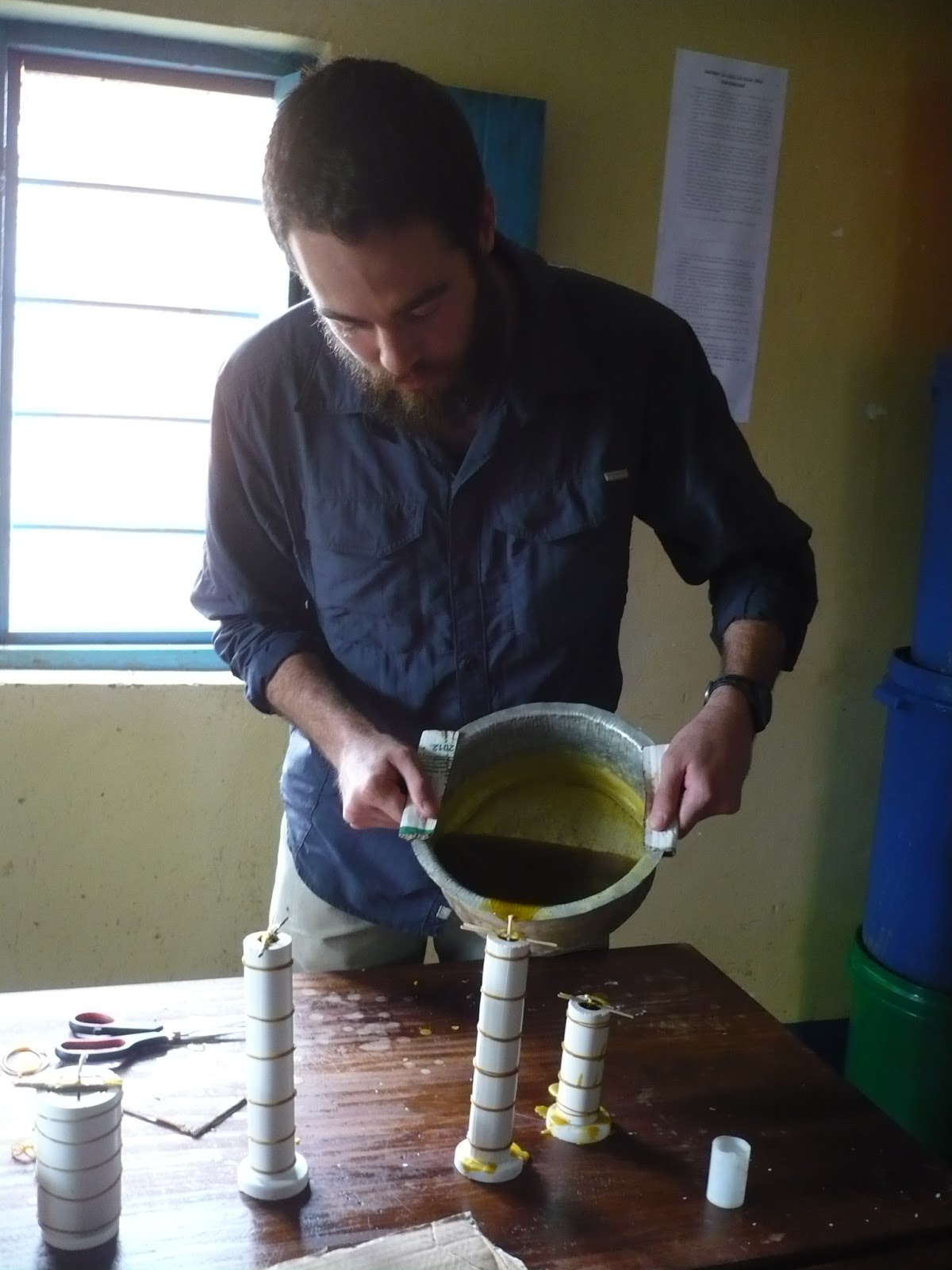
After the second filtration, the melted wax is poured into candle molds or large containers for bulk sell.


Unfortunately there isn't a market for wax in Tanzania or anywhere in East Africa. These candles would be sold for 1,000TZS (sixty cents) locally, but paraffin wax candles from China are readily available, less expensive, and favored by most Tanzanians. Export of wax to Europe and the United States, where it is used in cosmetics and furniture polish or turned into foundation for Langstroth Hives can be very profitable and is the best option available. Many traders are already doing this.

Tanzania is also lacking a reliable market for honey, which is very disappointing because the country is capable of producing so much and could produce even more. Honey is superabundant in much of the country (Tabora alone probably produces enough to satisfy the local demand) which greatly reduces the price. The prices are better when sold in Dar es Salaam. The problem is that most Tanzanians do not consume honey as a table food. It is mostly used as medicine and not a regular part of the diet. Fortunately, surrounding countries where honey is consumed regularly, like Rwanda, Uganda, and Kenya, are producing very little honey (I was told that 80% of the honey consumed in Kenya is from Tanzania) which means a market is very close if someone has the resources and contacts to transport their products out of the country. Many Ugandan and Kenyan merchants are coming here themselves. I should also mention that Tanzanian honey meets EU standards for export and businesses like Honey Care are sending honey to Germany, but I think the best option is to capitalize on the market in East Africa.

15 December, 2012

The Wild West (Part II)

Some fine dining at Sun City in Kigoma - the nicest Tanzanian hoteli I have found so far.


Water Scorpion - order Hemiptera; family Nepidae.


Dung beetle action shot!


This young chimp was very active.


Kakombe Waterfall

Some baboons.

Classic stink horn (family: Phallaceae)... I was walking with my guide when I saw this and said "Hey, this is a cool mushroom." Being very guide-like he stopped, reached down, and before I could say "Don't touch it," he picked it up. These fungi spread their spores by being particularly smelly and using things like ants and flies as dispersal agents. I felt bad that my guide had the "stink" on him for the rest of our expedition.

Reproductive termite on its voyage to begin a new colony. Just before a rain you see them flying everywhere! Eventually they find a suitable place, land, and eject their wings. I have been told that these are commonly eaten by people living in the forest. They are grilled over charcoal and then eaten with ugali. I'm on the lookout!

Zebras grazing near Lake Tanganyika just outside of Kigoma town.

Some camera-shy Vervet Monkeys coming to steal my mangoes. Males have bright blue genitalia (not visible here).

Happy Thanksgiving! I spent the day snorkeling and watching for crocodiles.